Four historic figures are giving their perspectives of the 1777 Battles of Saratoga via an interactive display.
Duty Calls: Museum interactive display details Battles of Saratoga
Times Union


URL has been copied successfully!
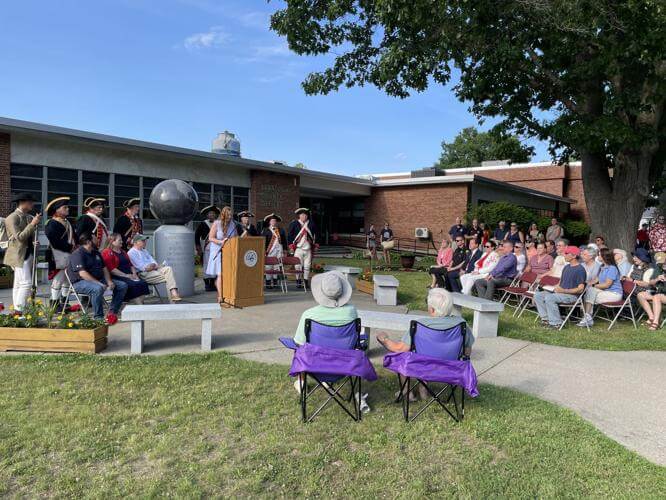
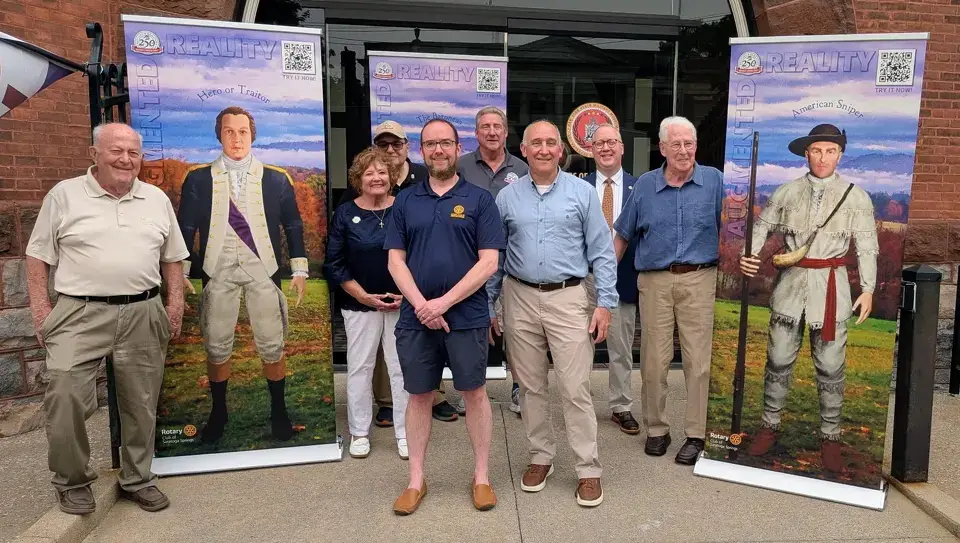
Saratoga 250 board members Phil Klein, from left, Corinne Scirocco, Vinnie Asaro, Rotary Club president; Dan Klein, Jay Rifenbary, Saratoga 250; Richard Goldenberg, director of Military History, Mark O’Rourke, president of Board of Trustees of the Friends of the New York State Military Museum; and Charles W. Wheeler, Jr., trustee of Friends of the New York State Military Museum, stand in front of banners of historical figures.
Courtesy of Adam Mason for the Friends of New York State Military Museum
Likenesses of Continental Army Maj. Gen. Benedict Arnold, Lt. Gen. John Burgoyne, who led British forces; Col. Daniel Morgan, who led a regiment of frontier riflemen, and Baroness Frederika Charlotte Louise Riedesel, who accompanied her husband Gen. Friedrich Adolf Riedesel and three children during the Saratoga campaign, are displayed at the entrance of the New York State Military Museum and Veteran Research Center, 61 Lake Ave., Saratoga Springs.
Visitors can use their smartphones to watch these 3D figures materialize and share their personal perspectives on the events that played out along the upper Hudson River in September and October of 1777 as an invading force of British regulars, loyalists, Canadians, German mercenaries and Native American allies was defeated by the Continental Army and state militias.
“Visitors can use their cellphone to view 3D images of each of the four and hear them talk about their involvement in the history-changing Saratoga Campaign of 1777,” says Chris Carola, a military historian and Friends of the Military Museum spokesman.
The victory of the final battle at Bemis Heights was the turning point in the Revolutionary War. That victory prompted France to provide the Patriots with troops, materiel, money and naval assets, support that led directly to the British surrender at Yorktown in 1781 and to winning independence from England.
The Saratoga 250 display is among numerous events that celebrate the 250th anniversary of the founding of our nation. Saratoga 250 was underwritten by the Rotary Club of Saratoga and supported by the Friends of the Military Museum.
The interactive display is part of Saratoga County commemorations leading up to the 250th anniversary of the Battles of Saratoga. Other Saratoga 250 interactive displays are at the Saratoga Springs Public Library, Saratoga Springs History Museum at the Canfield Casino and the Saratoga Heritage Area Visitors Center.
At the New York State Military Museum, the prominent individuals are displayed on banners with QR codes that allow visitors to hear historic perspectives.
Arnold was a war hero during the battles but later became a traitor. Arnold became a hero as he was mounted on horseback and led American forces, during an attack on Hessian soldiers commanded by Gen. Heinrich von Breymann and the capture of a key British fortification called Breymann Redoubt. The Hessians were allies of the British. The capture of the position exposed the British on Bemis Heights overlooking the Hudson River and forced the British to withdraw and retreat. This led to the surrounding and surrendering of British forces on Oct. 17, 1777.
Three years after the Battles of Saratoga, Arnold became a traitor when he conspired to have British forces occupy West Point and capture Gen. George Washington. Arnold switched sides after Washington reprimanded and demoted Arnold to colonel.
Arnold later became a general of American loyalists who fought on the British side during the last part of the Revolutionary War.
Morgan’s sharpshooting skills played a key role in defeating the British, says Carola.
Frederika wrote firsthand accounts of her family’s harrowing experiences.
“This display offers a fun and interesting way to interact with some of the most prominent figures from our history and hear from them, in their own words, about the role they played at Saratoga,” said Bill Teetor, executive director of the Campaign for Saratoga 250.
“We are so pleased here at the Military Museum to add these augmented reality banners that can give a voice to the history here in Saratoga,” said Richard Goldenberg, director of military history for the New York State Division of Military and Naval Affairs. “Our commemorations of the Battles of Saratoga are a community-wide event, and we are thankful to the Saratoga Rotary Club and the Campaign for Saratoga 250 for their support in bringing these banners to our Revolutionary War exhibit floor.”
The museum is open from 10 a.m. to 4 p.m. Tuesdays through Saturdays.
For information on Saratoga 250 exhibits and events, visit saratoga250.com. For information on the New York State Military Museum, visit museum.dmna.ny.gov.


BE THE FIRST TO KNOW
Sign up for our email list to stay up-to-date on the Campaign for Saratoga 250.
 Keep America’s Turning Point Alive

Keep America’s Turning Point alive for generations to come by making a tax-deductible donation to the Campaign for Saratoga 250, Inc. Our certified 501c3 nonprofit organization is dedicated to promoting awareness, education, and preservation of critical assets of the Battles of Saratoga. Your support will help promote historical awareness of new generations of people across the region, nation, and globe.