Henry Knox’s Holiday Stay in Saratoga

By Lauren Roberts | Sponsored by the Saratoga County History Center

Share
Copy link
URL has been copied successfully!

Knox recreated artillery sled. Photo provided by Saratoga County History Center


Two hundred and fifty years ago, a 25-year-old bookseller from Boston was a guest in Stillwater on Christmas Eve. His name was Henry Knox, and he was on an important expedition. 

Sent by General George Washington, Knox was to retrieve artillery that had been taken from several forts captured by the fledgling American Army and bring them 300 miles to relieve the Siege of Boston in the winter of 1775. Knox, well-read and possessing incredible confidence for someone with his level of experience, left Boston in November and headed to Fort Ticonderoga where 59 pieces of artillery were selected to be part of his “Noble Train of Artillery,” a phrase penned by Knox himself in a letter to George Washington.

Knox arrived at Fort Ticonderoga on December 5th, 1775, and after overseeing the preparations for the first leg of the journey, which meant moving the cannon out of the fort and up to the landing at the northern end of Lake George, he proceeded ahead of the gun-laden boats and made his way to Fort George. His younger brother William stayed behind with the bateau, “pettiauger” and scow as they made their way up a cold, though not frozen, Lake George.

After Henry arrived at Fort George, he was delayed while waiting for sleds, draft animals and snow. While there, he had time to write in his diary and catch up on correspondence with Gen. Philip Schuyler, Gen. George Washington and his wife Lucy. In these letters he described weather conditions, anticipated timelines and logistics for the upcoming overland journey. Washington had ordered Schuyler to assist Knox on this mission, and, since Schuyler was familiar with both the local landscape and many of the contractors in the area, he was not shy about informing Knox who he should, and should not, be working with. Knox had contracted with George Palmer of Stillwater to “purchase or get made 40 good strong sleds… and likewise that you would procure oxen or horses as you shall judge most proper to drag them.” In the same letter, Knox goes on to promise Palmer that, “whatever expense you are at I shall pay you immediately.”

Palmer was a well-known Patriot, serving as a member of the Albany Committee of Correspondence. Though he clearly believed in the cause of independence, he may not have been above profiting handsomely from Knox’s naiveté. When Schuyler became aware of this agreement he pumped the brakes, telling Knox that paying Palmer to build new sleds for this journey was an unnecessary expense since these sleds already existed in the region and presumably could be hired at a much lower cost than what Palmer was about to charge.

Knox followed Schuyler’s sound advice, though it was clear that Palmer was not happy about this reversal. A letter from Palmer to Knox written on Christmas Day 1775 expresses his disappointment in the cancelation of the contract and even warns Knox that there may be dangerous consequences in letting down all the people who stood ready to assist the artillery train. If Knox responded to this thinly vailed threat, it has been lost to history.

Knox left Fort George ahead of the artillery to go to Schuyler in Albany and work out the new plan for obtaining sleds. Though pages of his diary are missing during this time, it seems that he left on December 24th in the middle of a heavy snowstorm. After noting that Judge “Dewer” helped him obtain a sleigh to get to Stillwater, he explains how difficult it was to make forward progress in the snow. Stopping at Arch McNeals in Saratoga (now Schuylerville) to take in a meal, they left there at 3pm, “it still snowing exceeding fast” and only made it to Stillwater before having to stop for the night. He spent the night at Ensign’s Tavern and woke up on Christmas morning to over two feet of snow on the ground. While he had worried just a few days earlier that there would not be enough snow for the sleds, now there was too much snow for him to even make it to Schuyler’s house. He notes, “we got a sleigh to go to Albany but the roads not being broken prevented our getting farther than New City (now Lansingburgh) about 9 miles above Albany – where we lodg’d.” 

Knox eventually made it to Schuyler’s house in Albany on December 26th though the travel continued to be very difficult and Knox “almost perish’d with the cold.” The first order of business was to send for George Palmer and see if an agreement could be reached regarding the much-needed sleds. A lengthy conversation took place between Palmer and Schuyler, but they remained at an impasse over the price Palmer demanded and he was eventually dismissed. Schuyler then took matters into his own hands to obtain the sleds and draft animals, sending out his wagon master to make connections with local teamsters. By New Year’s Eve, the wagon master had returned to Schuyler’s, with the names of the teamsters who were on their way to Fort George with sleds to begin loading the cannon. Knox estimated that approximately 124 pairs of horses were employed to move the 60 tons of artillery. While it is often thought that oxen were used exclusively to pull the artillery train, from Fort George to Springfield, Massachusetts, it was primarily horses that were given this task. 

With the matter of the sleds and draft animals settled, and the desired snow blanketing the ground, Knox and his noble train were finally on their way towards Boston. Though difficulties still lay ahead for this expedition, they wouldn’t experience any more significant delays and by the end of January, they had arrived in Cambridge. In the coming weeks Washington’s army would successfully mount several cannons atop Dorchester Heights in a move that convinced the British Army it was time to leave the city of Boston, which they did on March 17, a date still known as “Evacuation Day”.

Knox’s successful mission was a key victory in the American War for Independence. It showed the British that the American Army was capable of completing complicated expeditions, it showed Washington that Knox was someone he could rely on and it boosted the morale of the Patriots, who knew they were up against an army that bested them in numbers, experience, material and money. It was a feat worth celebrating. 

And even now, 250 years later, we are continuing that celebration. This December, a bi-state commemoration is taking place in honor of Knox. Programs and processions are taking place all the way from Crown Point to Dorchester Heights. In Saratoga County, several events are scheduled on December 13th and 14th, with Knox Fest at Fort Hardy Park, an 18th Century Candlelight Concert at the Arts Center on the Hudson in Mechanicville, and a ceremony at the Knox Trail Marker in Soldiers and Sailors Park in Waterford. These events are all free and open to the public and we encourage you to come experience this history in your backyard. For more information on these events, and others across the region, visit knox250.com.

Go to Website

BE THE FIRST TO KNOW

Sign up for our email list to stay up-to-date on the Campaign for Saratoga 250.

Sign Up Now

  Keep America’s Turning Point Alive  icon-star-red

Keep America’s Turning Point alive for generations to come by making a tax-deductible donation to the Campaign for Saratoga 250, Inc. Our certified 501c3 nonprofit organization is dedicated to promoting awareness, education, and preservation of critical assets of the Battles of Saratoga. Your support will help promote historical awareness of new generations of people across the region, nation, and globe.

Learn More

Continue reading

Students from the WSWHE BOCES Career & Technical Education program are bringing history to life through a unique hands-on project: constructing two full-scale replica sleds modeled after those used by Henry Knox to transport cannons from Fort Ticonderoga to Boston during the American Revolution.

Timber, Tradition, and Trades: Students Bring History to Life

May 30, 2025

Timber, Tradition, and Trades: Students Bring History to Life

Share
Copy link
URL has been copied successfully!

Students from the WSWHE BOCES Career & Technical Education program are bringing history to life through a unique hands-on project: constructing two full-scale replica sleds modeled after those used by Henry Knox to transport cannons from Fort Ticonderoga to Boston during the American Revolution.

BOCES-Knox-Trail

Students from the WSWHE BOCES Career & Technical Education program are bringing history to life through a unique hands-on project: constructing two full-scale replica sleds modeled after those used by Henry Knox to transport cannons from Fort Ticonderoga to Boston during the American Revolution.


by WSWHE BOCES

The project is part of a broader regional celebration of the historic 250th anniversary of the American Revolution. The sleds will be featured at several high-profile events, including the Washington and Saratoga County Fairs, the Philadelphia Orchestra performance at SPAC on August 6, and the Historic Knox Artillery Trail Commemoration through Warren, Washington, Saratoga and Albany Counties December 12-14th. They may also travel to Boston before becoming part of the New York State Museum’s Revolutionary NY 250 exhibit—and ultimately, its permanent collection.

Environmental Conservation and Forestry students from the Southern Adirondack Education Center milled oak lumber donated by the Queensbury Union Free School District. The trees, damaged by invasive gypsy moths and posing a safety risk to the school’s cross-country trail, were removed by the students to make the trail safer. The high-quality lumber from these trees was then used for the sled project. Students took special care to ensure the logs remained clean during transport, using a mini-excavator to avoid imperfections. “We wanted to make sure that every piece of wood was up to the task, especially since this project is so significant,” said  Instructor Tom Bromley. “The students also learned a lot about how the 18th-century use of mules and horses as transportation methods.”

“It was cool to be part of something that’s going to be seen at events and in a museum,” said Andrew Narduzzo, a senior from the South Glens Falls Central School District. “We learned how important it is to protect forests, and how much harder it was to move and process lumber in the 1700s. It definitely gave us a new appreciation for the work people used to do.”

The milled timbers are now being used by Construction Trades students from the F. Donald Myers Education Center who are building the sleds using 1770s construction techniques. “It’s interesting to use old tools and techniques, which are a lot different than what we’re used to,” said Dylon Emigh, a senior from Ballston Spa. Students created a mock-up to practice traditional joinery and even built a shave horse to shape wooden dowels.

“It’s pretty cool to think that our work will be showcased at major events and eventually be part of the State Museum’s permanent collection,” added Logan Pickett, a senior from Stillwater.

Instructor Ian Hamilton said he appreciates the collaboration and  partnerships with the historical societies of Saratoga and Washington Counties and Old School Designs Inc., which recreated the original plans based on Henry Knox’s drawings. “There’s a built-in history lesson here,” he said. “The students are learning craftsmanship, teamwork, and the importance of preservation all in one project

To document this unique journey, the Saratoga County 250th Commission and the Washington County 250th Commission are partnering to produce a documentary film chronicling the process from milling to final assembly—capturing not just the construction, but the learning, creativity, and pride of all the students involved.

“Including the WSWHE BOCES students in the 250th anniversary of Knox’s noble train of artillery has been one of the most exciting elements of planning this commemoration,” said Lauren Roberts, Chair of Saratoga 250th Commission.” Not only are they learning about an incredible historic event that happened right in their own backyard, but they are applying their skills to create sleds which will be used throughout the commemoration and ultimately end up in the state museum’s collection. There aren’t many students that can claim that as an accomplishment.”

Go to Website

BE THE FIRST TO KNOW

Sign up for our email list to stay up-to-date on the Campaign for Saratoga 250.

Sign Up Now

  Keep America’s Turning Point Alive  icon-star-red

Keep America’s Turning Point alive for generations to come by making a tax-deductible donation to the Campaign for Saratoga 250, Inc. Our certified 501c3 nonprofit organization is dedicated to promoting awareness, education, and preservation of critical assets of the Battles of Saratoga. Your support will help promote historical awareness of new generations of people across the region, nation, and globe.

Learn More

Continue reading

BOCES-Knox-Trail

BOCES students built Knox Train sleds to mark 250th

May 30, 2025

BOCES students built Knox Train sleds to mark 250th

Share
Copy link
URL has been copied successfully!

BOCES-Knox-Trail

Construction trades students Cody Tucker from Hadley-Luzerne and Maggie Horan from Mechanicville CSD working on the replica of the Knox artillery sled. Photo provided.


by Glens Falls Chronicle

The five-counties WSWHE BOCES planned a ceremonial send-off Wednesday, May 28, for two full-scale replica sleds built by Career and Technical Education students in the F. Donald Meyers Education Center in Saratoga Springs. Students used 18th-century construction techniques and tools to replicate the sleds by which General Henry Knox and his troops transported captured cannons from Fort Ticonderoga to Boston during the harsh winter of 1775-1776.

They went 300 miles in 56 days, arriving Jan. 25, 1776. In March the artillery helped drive the British out of Boston.

Environmental Conservation and Forestry students from BOCES’ Southern Adirondack Education Center in Hudson Falls milled oak timbers they harvested from trees on the Queensbury school campus.

“The students have been exposed to skills and tools that they’d otherwise never experience in a modern shop,” Construction Trades instructor Ian Hamilton was quoted. “There’s a built-in history lesson here — and I’ve been proud to see their creativity and pride in the process.”

“The trees, which were damaged by invasive gypsy moths and posed a safety hazard on the Queensbury school’s cross-country trail, were carefully selected and removed by students.

“They used a mini-excavator to prevent the logs from touching the ground and introducing imperfections in the wood — highlighting both sustainable forestry practices and historic awareness.”

“This project brings together so many important themes—education, conservation, and the region’s Revolutionary War legacy,” said Lauren Roberts, Saratoga County Historian and Saratoga 250th Commission chair, in the release.

“It’s incredibly exciting to see students connecting to history in such a tangible, meaningful way.”

“This event celebrates hands-on student learning, local collaboration and historic preservation in action,” writes BOCES Senior Public Information Specialist Maribeth Macica.

The sleds will be featured at high-profile events, including Washington and Saratoga County Fairs, the Philadelphia Orchestra’s August 6 Tchaikovsky Spectacular (including the 1812 Overture) at SPAC, and the region-wide Historic Knox Artillery Trail Commemoration, “before ultimately being accessioned into the New York State Museum’s permanent collection,” she wrote.

The project is in conjunction with regional efforts to mark the 250th anniversary of the Battles of Saratoga and the American Revolution.

A documentary film is also in the works, Ms. Macica wrote, to chronicle the collaboration between students, instructors, historians and community partners “from timber to trail.”

As for the send-off, the Saratoga County Department of Public Works planned to “carefully” transport the student-built sleds on a flatbed truck, Ms. Macica wrote, “with a Sheriff’s escort.”

A Henry Knox reenactor and staff from the New York State Museum planned to attend the “send-off.”

Go to Website

BE THE FIRST TO KNOW

Sign up for our email list to stay up-to-date on the Campaign for Saratoga 250.

Sign Up Now

  Keep America’s Turning Point Alive  icon-star-red

Keep America’s Turning Point alive for generations to come by making a tax-deductible donation to the Campaign for Saratoga 250, Inc. Our certified 501c3 nonprofit organization is dedicated to promoting awareness, education, and preservation of critical assets of the Battles of Saratoga. Your support will help promote historical awareness of new generations of people across the region, nation, and globe.

Learn More

Continue reading

Town of Saratoga Restores Historic Marker Honoring Henry Knox

April 24, 2025

Town of Saratoga Restores Historic Marker Honoring Henry Knox

Share
Copy link
URL has been copied successfully!
  • IMG_1761 (1)

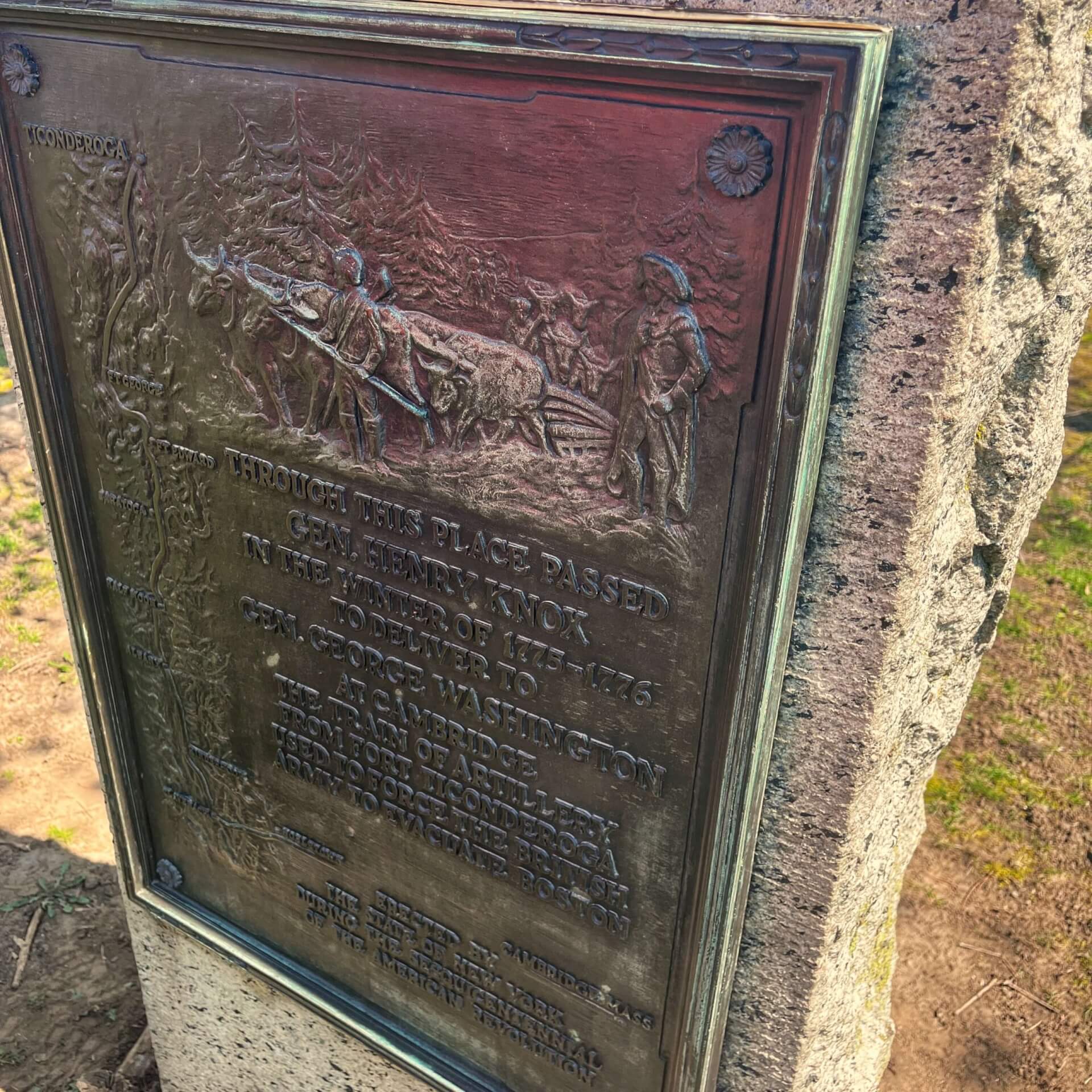
    A close-up of the restored Henry Knox marker, originally installed in 1926–1927 as part of one of the nation’s earliest heritage trails. Located on Broad Street in Schuylerville, the marker commemorates Knox’s daring winter trek to deliver artillery to General George Washington in 1776.

  • IMG_1760 (1)

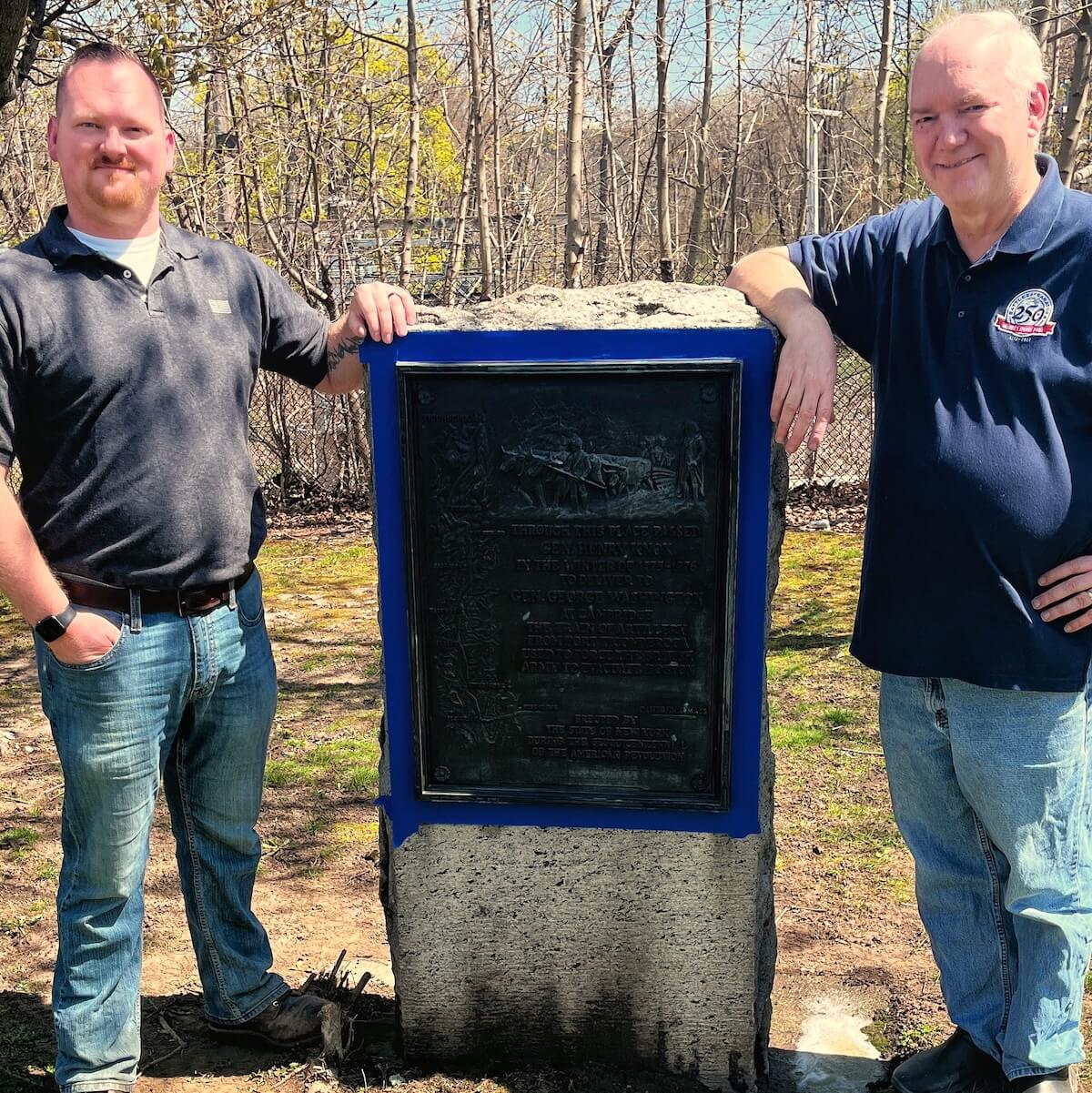
    Saratoga Highway Superintendent Ryan Campbell and Town Historian Sean Kelleher stand beside the newly restored Henry Knox Cannon Trail marker on Broad Street in Schuylerville. The restoration honors one of the Revolution’s most remarkable logistical feats and prepares the site for the upcoming Semiquincentennial commemoration.


SCHUYLERVILLE, N.Y. — To mark National Historic Marker Day, the Town of Saratoga has restored the historic Henry Knox marker in Veterans Park, reinforcing its commitment to preserving Revolutionary War heritage ahead of the nation’s Semiquincentennial.

Town crews, trained by the New York State Office of Parks, Recreation and Historic Preservation, cleaned the surface, and applied a fresh coat of polish to the roadside marker. The sign commemorates Knox’s 1775–1776 winter expedition to transport artillery from Fort Ticonderoga to Boston, a feat that helped force the British evacuation of the city and gave the Continental Army an early victory.

“It’s rewarding to see our team contribute to local preservation,” said Saratoga Highway Superintendent Ryan Campbell. “The training we received from the State Historic Preservation Office has made a real difference, especially as we prepare for the 250th anniversary of the Revolution.”

The project is part of the town’s broader efforts to prepare for the 250th anniversary of the American Revolution, which will be observed nationwide in 2026. Saratoga County, home to the turning point of the war, is coordinating a series of commemorative events through the Saratoga 250 Commission.

“The Knox marker connects our community to a pivotal moment in American history,” said Town Supervisor Ian Murray. “We’re proud to preserve it and to support the Saratoga 250 Commission as we plan events that will welcome visitors from across the country.”

On July 20, Saratoga 250 will host a joint Masonic ceremony honoring Knox in Schuylerville, with representatives from the Grand Lodges of New York and Massachusetts. A second Saratoga 250 commemorative event is scheduled for Dec. 13 at Fort Hardy Park, near where Knox crossed the Hudson River with his artillery train.

Town Historian Sean Kelleher said the restoration is part of a larger initiative to maintain the visual landscape of the Revolution. “Schuylerville is often called ‘America’s Most Historic Village,’ and for good reason,” Kelleher said. “As we approach the 250th anniversary, it’s essential that these markers remain visible and meaningful to the next generation.”

Founded by the William G. Pomeroy Foundation in 2021, National Historic Marker Day encourages volunteers and municipalities to clean, repaint and document historic signs that are often overlooked but vital to public memory.

The Town of Saratoga’s work on the Knox marker not only protects a key piece of local Revolutionary War history but also models the kind of stewardship being encouraged across the nation in preparation for 2026.

For more information about upcoming Saratoga 250 events, visit saratoga250.com

BE THE FIRST TO KNOW

Sign up for our email list to stay up-to-date on the Campaign for Saratoga 250.

Sign Up Now

  Keep America’s Turning Point Alive  icon-star-red

Keep America’s Turning Point alive for generations to come by making a tax-deductible donation to the Campaign for Saratoga 250, Inc. Our certified 501c3 nonprofit organization is dedicated to promoting awareness, education, and preservation of critical assets of the Battles of Saratoga. Your support will help promote historical awareness of new generations of people across the region, nation, and globe.

Learn More

Continue reading