1776: The First Year of Independence – From Colony to State
Written by James Richmond
This is the third in a series of articles highlighting the 250th anniversary of our nation’s independence, focusing on Albany County, New York, which, in 1776, stretched from Kingston north to Lake George. This series follows several articles published in 2025 under the title “1775: The First Year of Revolution,” also available at Saratoga250.com.

Reading of the Declaration of Independence in White Plains July 11, 1776
The Revolutionary War came early to New York in 1776. And it was not initiated by British troops, but rather by the actions of the Second Continental Congress in Philadelphia. In December 1775, 788 Queens County residents (78%) voted against supporting the revolutionary movement, refusing to send delegates to the colony’s Provincial Congress. On January 3 the Continental Congress dispatched 1,200 militiamen from New Jersey and Connecticut to Queens to “put out of the protection of the United Colonies all such persons as voted against sending deputies to the present convention of New York.” Their penalty for boycotting New York’s Provincial Congress included confiscation of their weapons, and restrictions on trade and travel. Taken by surprise, Queens loyalists were rounded up and forced to sign a “submission document” pledging not to take up arms against the United Colonies. Twenty-six prominent Queens citizens and wealthy landowners were taken prisoner and sent to Philadelphia pending their parole.
This raid was the first military action conducted by the Continental Congress to suppress local political opposition to the revolutionary movement. As the conflict escalated in 1776, New York City and surrounding counties were a hotbed of support for the British cause. Wealthy merchants such as the De Lancey family and Royal government officials dominated the politics of New York City, while the quasi-feudal landed aristocracy, represented by Frederick Philipse III of Philipseburgh Manor in Westchester County, controlled vast estates in the Hudson Valley. They relied on their relationships with the British for their political and economic dominance.
In spite of the Loyalists’ power, the resistance movement was successful in creating the extra-legal Provincial Congress in May 1775, after Lexington and Concord turned the dispute into open warfare. Since then, delegates had supported the decisions of the Continental Congress to boycott British trade, establish a Continental Army, raise troops, and invade Canada.
The question arises – why did the Continental Congress take the lead? In New York, the Provincial Congress was the de-facto leader of the resistance to British hegemony. Why did they not deal with the Loyalist threat? While delegates to the New York Congress were all Whigs, all opposed to British overreach, all supportive of the United Colonies’ efforts to protect the rights of their citizens, at the beginning of 1776 most were not yet prepared to abandon hope that an accommodation could be reached and the uncertainties of independence avoided. They feared calling out the Loyalists in their midst – their friends, neighbors, relatives, and business associates – would end all hope of reconciliation. This conservative faction controlled the Provincial Congress and delayed New York’s support for independence during the first six months of 1776 while other colonies took the lead.
The “United” Colonies
As the year began the question of independence was also undecided in Philadelphia. Members of the Continental Congress were roughly divided into two factions. The New England colonies, and their lead spokesmen, John and Samuel Adams, argued that the opportunity for reconciliation had passed. Lexington and Concord, the bloody battle of Bunker Hill, the invasion of Canada all pointed toward full scale war for independence. The moderates led by Pennsylvanians John Dickinson and James Wilson feared that crossing that bridge would bring inevitable defeat by the most powerful empire in the western world. Most importantly, they expressed the concerns of many colonialists. Support for independence had not yet solidified in January 1776. However, over the next three months everything changed. As discussed in our first 1776 article, Common Sense, the shift in public opinion was driven by Thomas Paine’s pamphlet, King George’s rejection of the Olive Branch Petition, and the British military preparations for all-out war.
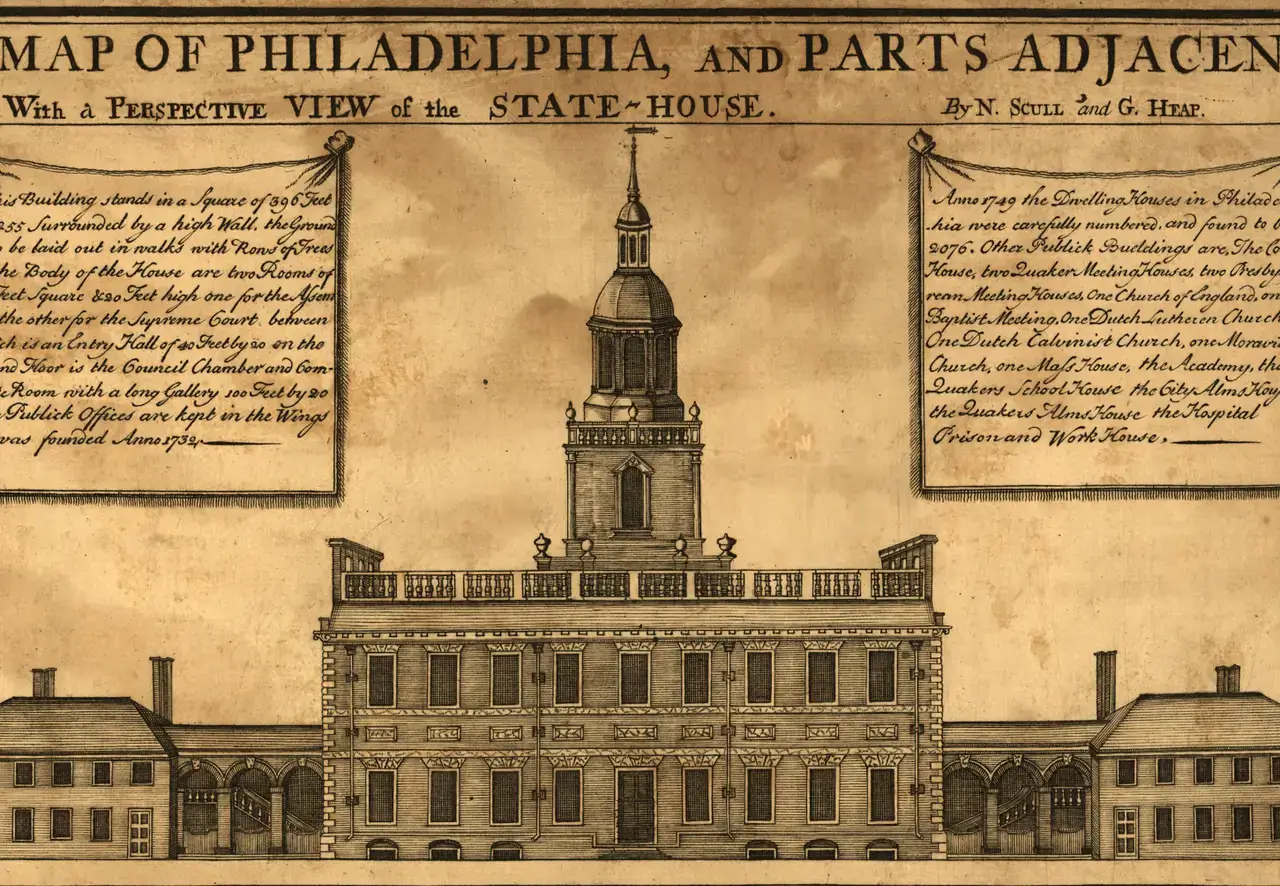
Pennsylvania State House – Independence Hall
In February, the moderates in Congress proposed An Address to the Inhabitants of the Colonies which was fiercely debated in the Pennsylvania State House, today known as Independence Hall. Drafted by James Wilson of Pennsylvania, the document tried to bridge the gap between themselves and the radicals in providing guidance to the colonies. It conceded that the actions of the Congress to put the colonies on a war footing were justified, stating
That all power was originally in the people – that all the Powers of the Government are derived from them – that all such power are maxims of the English Constitution, which cannot be disputed.
Yet the document refused to make the case for independence from the British empire.
We are accused of carrying on the War for the purposes of establishing an independent empire. We disavow the intention. We declare, that what we aim at, and what we are entrusted by you to pursue, is the defense and the re-establishment of the constitutional rights of the Colonies.
The more radical supporters of independence were furious. John Adams, writing to his wife Abigail, expressed his frustration: “America is a great, unwieldy body. It is like a large fleet sailing under convoy. The fleetest sailors must wait for the dullest and slowest.”
Sensing that the opinion of the people was shifting, the Congress voted to table the Address which was never sent to the colonies. The pro-independence New Englanders had seized the initiative and John Adams moved to solidify that support.
In April, Adams composed a series of letters addressing a key concern of the colonies in moving toward independence. If they abandoned the British monarchal structure, what would replace it? Compiled into a pamphlet entitled “Thoughts on Government”, Adams outlined the basic structure of a Republic: A bicameral legislature and separation of powers between the legislature, the executive and the judiciary. As the colonies took up the question of independence in the spring of 1776, these tenants were built into their new state constitutions, which became the proving ground for the governmental structure formalized in the United States Constitution in 1787.
One by one the colonies threw off British rule, became independent states and urged the Continental Congress to declare independence for the United States. The states led and the nation followed.
North Carolina was the first colony to authorize its delegates at the Continental Congress to support independence. On April 12 they unanimously
Resolved that the delegates for this Colony in the Continental Congress be impowered to concur with the other delegates of the other Colonies in declaring Independency, and forming foreign Alliances.
A month later, on May 15, Virgina’s Convention went a step further by authorizing their delegates to not only go along with other colonies, but to lead them.
Resolved, unanimously, That the Delegates appointed to represent this Colony in General Congress be instructed to propose to that respectable body to declare the United Colonies free and independent States, absolved from all allegiance to, or dependence upon, the Crown or Parliament of Great Britain.
On the same day Virgina passed their resolution, the Continental Congress, sensing the tide had turned, empowered the colonies to make the final break with the British Empire, authorizing them to establish their own governments.
Resolved, That it be recommended to the respective assemblies and conventions of the United Colonies, where no government sufficient to the exigencies of their affairs have been hitherto established, to adopt such government as shall, in the opinion of the representatives of the people, best conduce to the happiness and safety of their constituents in particular, and America in general.
Momentum was building. Ironically this resolution, passed on the first floor of the State House, proved to be the downfall of the royalist Pennsylvania Assembly which met on the second floor. To this point, Pennsylvania had been one of the most difficult colonies to get on board. Their Provincial Assembly, controlled by wealthy moderates and Quakers, had previously ordered its congregational delegates to “utterly reject” any resolutions supporting independence.
Five days later on May 20, the people spoke. Gathering on the grounds outside Independence Hall, 4,000 demonstrators called for the replacement of the Provincial Assembly by a new legislature supporting independence. Committees of Correspondence throughout the counties selected members of this new revolutionary body which met at Carpenter’s Hall – the 1775 meeting place of the First Continental Congress – and on June 24 authorized Pennsylvania’s delegates to support independence.

Richard Henry Lee
New York Responds
On June 8, the day after Richard Henry Lee challenged the Continental Congress to declare independence, the New York delegates penned a frantic note to their Provincial Congress.
Your delegates here expect that the question of independence will be very shortly agitated in Congress. Some of us consider ourselves as bound by our instructions not to vote on that question and we all wish to have your sentiments thereon.

New York City Hall in 1776
Meeting in the old New York City Hall three days later John Jay, a moderate Whig, who at this point wanted to slow walk the rush to independence, drafted the Provincial Congress’ reply that began with a clear message about their instructions.
Resolved that the good people of this Colony have not, in the opinion of this Congress, authorized this Congress, or the delegates of this Colony in the Continental Congress, to declare this Colony to be independent of the Crown of Great Britian.
The case seemed closed. New York would not join the other colonies. But wait. There was more.
But whereas the perseverance of the British King and Parliament in a unjustifiable attempt to subjugate and enslave these United Colonies…Resolves unanimously it is hereby earnestly recommended to all the freeholders in this Colony at the ensuing election to be held in pursuance of a resolution of the [Provincial] Congress of the 31st day of May last…to inform their said deputies of their sentiments relative to the great question of independency.
In fact, Congress had already authorized an election for a Fourth Provincial Congress to succeed them, fully expecting that the new congress would support independence. The resolution announcing the election made that clear. The voters were asked
Either to authorize their present deputies, or others in their stead…to take into consideration the necessity and propriety of instituting such new government as by the said resolution of the Continental Congress.
By this time, it was not a question of if a new government should be formed, but who would be elected to make it happen.
Not surprisingly, the resulting election, which was completed in the counties and their districts by the end of June, mostly elected the same delegates as the Third Congress. The decision to join the other colonies was not the result of the election of more radical delegates to the Provincial Congress, but rather due to the same delegates changing their minds.
The delegates in the new congress, having received the approval of their constituents, were now poised to support independence, realizing that there was no feasible alternative, no further hope for reconciliation with the King or the Ministry. However, there was one more turning point that confirmed their decision. The British were coming. In force.
On June 11, the same day that John Jay posted his reply, the Provincial Congress received a letter from John Hancock, President of the Continental Congress.
Gentlemen — The Congress have this day received advices, and are fully convinced, that it is the design of Genl. Howe to make an attack upon the city of New-York as soon as possible. The attack they have reason to believe will be made within ten days…The important day is at hand that will decide not only the fate of the city of New-York, but, in all probability, of the whole Province.
On June 28 the first ships of the British invasion fleet were sighted off Sandy Hook. Two days later the Third Provincial Congress adjourned and directed that the newly elected Fourth Congress would assemble at the Westchester County courthouse in White Plains on July 9, removed from the immediate danger of the British fleet seizing control of the waters surrounding Manhattan Island. By that time General Washington’s scouts counted over 100 ships preparing to land over 30,000 troops on Staten Island. So, on July 2, 1776, in Philadelphia 12 colonies voted to declare independence, while New York’s delegates abstained, not yet empowered to join them.
The Albany Influence
150 miles upriver, Albany County, the largest and most populous county in the colony, was focused on the election for delegates to the Fourth Provincial Congress. As mentioned above, it was really no contest, yet it was an important step to confirm that eligible voters in the city, the hamlets and the countryside had the opportunity to make their voices heard. The elections were to be conducted by the local leaders of the county committee. Each of the twelve districts was to select one man to represent them in White Plains on July 9.
Not surprisingly, all the Albany County men serving in the Third Congress were reelected. Were these men ardent or reluctant supporters of independence? Did they follow the pattern of the Continental and Provincial Congresses, split between radicals and moderates?
Overall, the Albany delegation to the Provincial Congress more strongly favored independence than did the delegates from New York City and the lower Hudson Valley who were much more cautious. As discussed in our 1775 articles, Albany Steps Up and Leadership, Dutch men controlled the Albany City Council as well as trade with the Iroquois, until Sir William Johnson was appointed Superintendent of Indian Affairs in 1755. Disputes between Albany settlers and British troops during the French and Indian War heightened the tension. After the defeat of the French, the lands of the Kayaderosseras Patent became available for settlement by Yankees arriving from New England. The Albany delegates reflected these dynamics which were exacerbated by the invasion of Canada that brought the conflict to their doorstep.

Abraham Yates, Jr.
The State of New York
When the Albany delegation arrived, they joined 107 men who were just receiving word that the Continental Congress had voted for independence on July 2 and formally published the Declaration two days later. On July 9 the Declaration was read and John Jay offered a resolution that was adopted unanimously.
That the reasons assigned by the Continental Congress for declaring the United Colonies free and independent states are cogent and conclusive, and that, while we lament the cruel necessity which has rendered that measure unavoidable, we approve the same, and will, at the risk of our lives and fortunes, join with the other colonies in supporting it.
The next day the “Provincial Congress of the Colony of New York” changed its title to “The Convention of the Representatives of the State of New York.” Abraham and Robert Yates drafted a cover letter transmitting the Declaration to the Albany Committee where it was published and read to Albany citizens on July 19 from the steps of City Hall.
On August 1 a thirteen-member committee was formed to create the first constitution of the new state. Both Abraham and Robert Yates served on the committee. Abraham was appointed chairman, guiding the process while most of the details of the Constitution were drafted by John Jay, Robert R. Livingston and Gouverneur Morris. The resulting document followed much of the Thoughts on Government that John Adams had proposed in April. Its provisions, which included an elaborate system of checks and balances between the legislative, executive and judicial branches, proved to stand the test of time, remaining largely unchanged until 1821.
Amid the hardships of war and revolution, New York had become a state in the new nation.
Sources:
American Scripture: Making the Declaration of Independence, Pauline Maier, 1997
Constitutional History of New York, Vol 1, Charles Z. Lincoln, 1905
Declarations Before THE Declaration of Independence, Ray Raphael, Journal of the American Revolution, June 30, 2026
Journals of the Continental Congress 1774-1789, vol 4 and 5, Government Printing Office,1906
Journals of the Provincial Congress, Vol 1, Albany, 1842
Letters of Delegates to Congress 1774-1789, Paul H. Smith, editor, Library of Congress, 1985
Minutes of the Albany Committee of Correspondence 1775-1778, compiled by James Sullivan, State Historian, 1923
New York’s Response to the Declaration of Independence, New York Almanack, July 3, 2026
The American Revolution in New York, Alexander C. Flick, 1926
The Political Revolution and New York’s First Constitution, William A. Polf, 1977
Thoughts on Government, John Adams, 1775 in The Constitution and Other Founding Documents, 2026
Revolution Song: A Story of American Freedom, Russell Shorto, 2018
Image credits:
The Birth of New York State” by George A. Harker, ca 1915
Pennsylvania State House (Independence Hall), from 1752 map of Philadelphia. LOC.gov
Richard Henry Lee Engraving by J.B. Longacre, LOC.gov
New York City Hall in 1776, Engraved by George Hayward, 1856
Abraham Yates, Jr., Engraved by Max Rosenthal c. 1860
 Keep America’s Turning Point Alive

Keep America’s Turning Point alive for generations to come by making a tax-deductible donation to the Campaign for Saratoga 250, Inc. Our certified 501c3 nonprofit organization is dedicated to promoting awareness, education, and preservation of critical assets of the Battles of Saratoga. Your support will help promote historical awareness of new generations of people across the region, nation, and globe.