1775: The First Year of Revolution – The Iroquois Dilemma
Written by James Richmond
This is the fifth in a series of articles highlighting the 250th anniversary of the real beginning of the American Revolution in upstate New York, focusing on Albany County which, in 1775, stretched from Kingston north to Lake George

Iroquois conference at Johnson Hall
Philip Schuyler, just appointed by the Continental Congress as the Major General of the Northern Department, arrived in Albany on July 2, 1775, intent on quickly proceeding to Fort Ticonderoga. Having finally received the approval to move ahead with an invasion of Canada to secure their allegiance to the American cause as the Fourteenth Colony, the General had much to accomplish with inadequate resources.
So it was with a sense of frustration that he wrote to the Continental Congress on July 15 from his country home at Saratoga:
The information contained in the [enclosed] letter is so truly alarming that although I should have been at Ticonderoga tomorrow, I think it is advisable to remain a day here, in which I may probably receive some further accounts that will determine whether my presence may not be more necessary in Tryon County than at Ticonderoga.
The enclosed letter from the Tryon County Committee of Safety was the cause of his consternation. That letter from the patriot leaders in the newly formed county just west of Albany, informed the Albany Committee that upwards of 900 Iroquois warriors were poised to “fall on the American inhabitants below the Little Falls.” With little means to resist such an invasion, the Mohawk Valley Patriots looked to the Albany committee and Schuyler “to save this County from Slaughter and Desolation.”
So why had the Iroquois (Haudenosaunee) Confederacy taken the side of the British so early in the Revolution? The short answer is that they had not. This rumor that had caused so much fear in the valley was a false alarm. Schuyler was able to proceed on his way to Ticonderoga with little interruption.
However, to understand the positions of the multiple participants in this dispute, it is necessary to go back almost exactly one year to July 11, 1774. It was on that date that Sir William Johnson suffered a stroke and died at Johnson Hall while hosting a council with representatives of the Iroquois nations, one of many he had led dealing with land disputes during his twenty years as Indian Commissioner.
During that time, he forged an alliance and strong bond with his Native American neighbors, addressing their needs and concerns, even becoming one of them through his relationship will Molly Brandt. Perhaps his most important contribution was the 1768 Treaty of Fort Stanwix meant to guarantee Iroquois possession of the land west of the Proclamation Line of 1763. It was white settler encroachment beyond this treaty line that was the subject of his final conference.
In failing health, he had appointed his nephew Guy Johnson as his successor earlier in 1774. Although well respected in his own right, he was not Sir William. To complicate the transition, in the years leading up to the Revolution cracks began to appear within the Confederacy and in their relationship with their European neighbors.

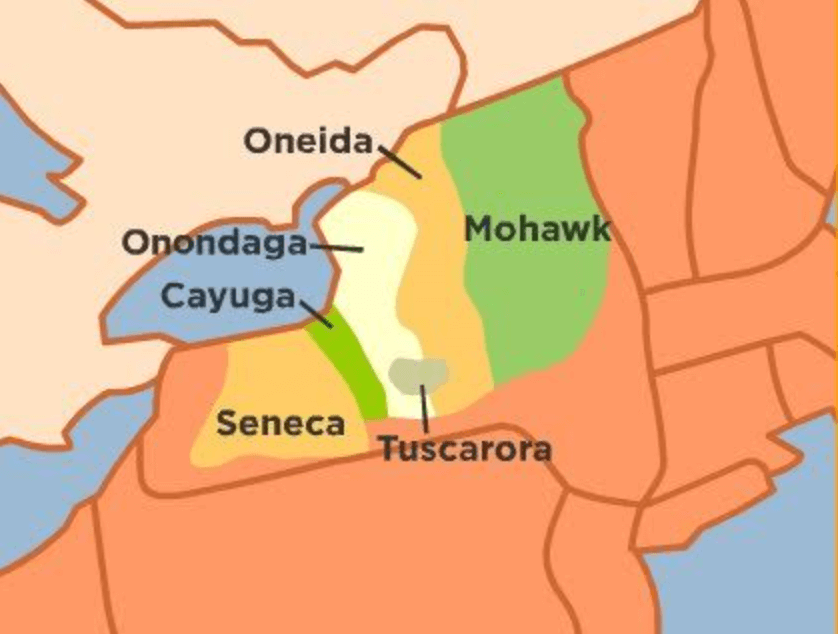
The Iroquois may have been known as one confederacy, but they consisted of six nations each with their own history, responsibilities and experiences. The Mohawks, who guarded the eastern door were most exposed to the settlers moving into their region. In addition to their close relationship with the Johnson family, they were also engaged in long-term disputes over land grants impinging on their territory. The most consequential of these controversies involved the Kayaderosseras Patent, which was finally resolved in 1768 with the release and partitioning for settlement of over 400,000 acres of Mohawk land in the northern section of Albany County, which would later become Saratoga County. There were other examples of frictions between the tribe and colonial leaders, including the fraudulent land claims made by the Dutch controlled Albany city government. They had previously claimed 1,000 acres surrounding the “Lower Castle” at Fort Hunter only to be overruled by the royal colonial governor William Crosby.
Interestingly, religion also played a role in the Iroquois – Settler interactions. Jesuit missionaries had attempted to convert some Iroquois groups with varying levels of success in the seventeenth century. The Mohawk nation had been strongly influenced by Anglican missionaries since the eighteenth century. Most influential in the years prior to the American Revolution may have been the ministry of Samuel Kirkland to the Oneidas, the nation just west of the Mohawk land. A “new light” minister from Connecticut, his message and concern for his followers influenced both the Oneidas and the nearby Tuscarora nation to look favorably upon the Americans in the looming conflict.
Another aspect of the Iroquois response to the pending storm was the interplay between the three internal power centers within the Confederacy. A matriarchal society, women played an important role in the decisions of the nations, significantly influencing the actions of the warriors and sachems. These tribal chiefs were typically chosen by the clan mothers and usually counseled restraint as conflicts arose.
In the years leading up to the American Revolution, the power of the Confederacy was on the decline. Previously, the Iroquois ability to control their own destiny hinged on the century long conflict between the British and French empires. By deftly positioning themselves as “aggressive neutrals” – favoring first one side and then the other – the Iroquois were moderately successful in achieving their primary goal, which was to protect their land from encroachment by the growing numbers of white settlers. With the defeat of the French in the Seven Years War, preserving their autonomy became much more difficult. The advent of the Revolution provided an opportunity for the Iroquois to regain their leverage by again appealing to both sides in a new conflict.
This background gives some context to the events as they unfolded between the European contestants in 1775 and the role played by the Iroquois.
As tensions continued to rise after the opening of hostilities at Lexington and Concord, Guy Johnson took actions to secure the loyalty of the Iroquois to the British crown. From Boston, General Thomas Gage exhorted Johnson to remove the threat posed by the Congregationalist missionaries. In May, Johnson prevented Kirkland from returning to the Oneidas, essentially placing him under house arrest for a time. The Albany Committee, aware of Johnson’s increasing hostility to the American cause warned him in a letter that
These Proceedings will if not speedily stopped, raise the resentment of the People we fear, and cause them to undertake such Acts as will not be in the Power of any Authority to restrain.
Guy Johnson ignored the Committee’s threat, but prudently called the Iroquois to a conference at Oswego, out of reach of the revolutionaries. In a confab attended by 1,500 men, women and children from several Iroquois nations, he claimed they agreed to “assist his Majesty’s troops in their operations.” Then he, accompanied by 220 Iroquois – most notably Joseph Brant, whose sister Molly was the widowed consort of Sir William – took passage to Montreal in July, temporarily leaving the field to others. Their journey continued to England where they were welcomed and encouraged to return to New York to continue their resistance to the American cause, which they did in July 1776.
However, Guy Johnson’s departure did not resolve the Iroquois dilemma. Most were still solidly positioned on the fence in this conflict. While General Schuyler was now free to concentrate on his preparations for the invasion of Canada, he realized that the unresolved Iroquois situation needed to be addressed. Unlike Johnson, he did not pressure them to take sides, but rather to remain neutral. In this effort, he had an unusual ally – a Mohawk chief.
Schuyler arranged for a conference with the Iroquois which was held in late August 1775 at the Albany Dutch church, mostly attended by representatives of the Oneida and Mohawk nations. Representing the Americans were four commissioners appointed by the Continental Congress including Schuyler and Volkert Douw, former mayor of Albany. The commissioners assured them that the Americans had no nefarious intentions and would support the continued presence of Christian missionaries among them.
The principal speaker for the Iroquois was Little Abraham, a Mohawk Pine Tree Chief appointed for his leadership skills. He was not pleased with the Commissioners refusal to accept responsibility for resolving land disputes with the Mohawks, a sticking point that would later prove injurious to the American cause. However, Little Abraham believed that the future of both his Mohawk nation and the Confederation hinged on avoiding taking sides in the conflict as long as possible. The Indian Commissioners and the Albany Committee were pleased with his response:
This then, is the determinations of the Six Nations. Not to take any part, but, as it is a family affair, to sit still and see you fight it out…for we bear as much affection for the King of England’s subjects upon the other side of the water, as we do for you, born upon this island.
General Schuyler had achieved his immediate goal to keep the Iroquois out of the war. But the contest of wills was not over. Although Guy Johnson had left the scene, William’s son, Sir John Johnson remained a threat in the valley. However, that is a 1776 story.
Sources:
American Archives Series 4 and 5, Peter Force, Northern Illinois Digital Collection
Iroquois Diplomacy on the Early American Frontier, Timothy J. Shannon, 2008
Journals of the Provincial Congress of New York 1775-1777. Google books
Journals of the Continental Congress, Library of Congress, 1775
Minutes of the Albany Committee of Correspondence 1775-1778, compiled by James Sullivan, State Historian, 1923
Suspected on Both Sides – Little Abraham, Iroquois Neutrality and the American Revolution, Caitlin A. Firtz, 2008
The Iroquois in the American Revolution, Barbara Graymont, 1972
The Minute Book of the Committee of Safety of Tryon County, 1905
Thomas Gage Papers vol 127, University of Michigan Library Digital Collection
 Keep America’s Turning Point Alive

Keep America’s Turning Point alive for generations to come by making a tax-deductible donation to the Campaign for Saratoga 250, Inc. Our certified 501c3 nonprofit organization is dedicated to promoting awareness, education, and preservation of critical assets of the Battles of Saratoga. Your support will help promote historical awareness of new generations of people across the region, nation, and globe.