1775: The First Year of Revolution – The Invasion of Canada
Written by James Richmond
This is the seventh in a series of articles highlighting the 250 th anniversary of the real beginning of the American Revolution in upstate New York, focusing on Albany County which, in 1775, stretched from Kingston north to Lake George.

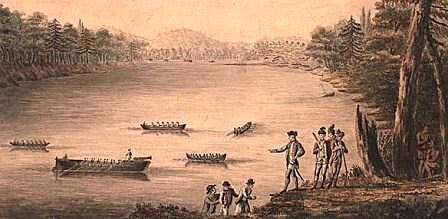
Northern Army embarking from Crown Point August 31, 1775
For the first six months of 1775, Albany County was one step removed from the center of action in the First Year of Revolution. That is not to say the county remained uninvolved in the resistance to the ministerial actions of the British Crown, as described in previous articles in this series. Albany leadership organized in support of the Continental Association. Local districts formed committees and organized militia units. Loyalist leaders such as Guy Johnson were forced to retreat to Canada, others were under scrutiny. The Iroquois Confederacy, predisposed to support its British protectors, were encouraged to remain neutral in this dispute between brothers.
However, the growing conflict was soon to have a more direct impact. Beginning in July 1775, Albany County played a significant role in the first American military campaign of the Revolutionary War. With the appointment of Philip Schuyler to command the Northern Department of the Continental Army, Albany and the waterways of the “Great Warpath” became center stage in this campaign.
Immediately the Continental Congress struggled to make an important decision. Should the thirteen “United Colonies” seek to add a fourteenth? In Philadelphia, the initial answer was “No.” On June 1st, Congress resolved to defend Fort Ticonderoga and Crown Point, captured in May by Ethan Allen and Benedict Arnold, but opposed military action “by any colony, against or into Canada.”
Four weeks later, Congress reversed that decision on the strength of a letter received by the Albany Committee citing intelligence provided by Dirck Swart. A member of the Saratoga District Committee operating undercover in Canada, Swart passed on two critical pieces of information. First, that “the French Caughnuago Indians had taken up the hatchet in support of the British cause.” Secondly, that the British garrison at Saint Jean on the Richelieu River was “building floating batteries and boats”, presumably in preparation for an attack on the American held forts along Lake Champlain.
The Continental Congress jumped into action…sort of. On June 28th they directed General Schuyler “to take possession of Saint Jeans and Montreal if he finds it practicable and not disagreeable to the Canadians.” This ambiguous order highlights the dilemma facing the Americans. Focused on defending liberty and freedom from the overreach of the Ministerial government, the prerequisite for an invasion required the concurrence of the Canadian people that they too were being abused. Determining their mindset would prove an important consideration in the decision to proceed with any invasion. In fact, there was significant support
for the American cause there which contributed to the decision to begin the campaign.
Schuyler arrived at Ft. Ticonderoga on July 18th, and over the next month was able to assemble the troops and supplies necessary to launch the invasion. It was not an easy task. Regiments authorized for the Northern Army were in various stages of assemblage. At Ticonderoga he was met by a mere 100-man garrison. Six weeks later 2000 men were quartered there and another 550 at Crown Point, the army’s most northerly post.
Principally consisting of four newly formed regiments from New York and others from Connecticut, Schuyler first encountered the friction between “Yorkers” and “Yankees” that would come back to haunt him two years later. One principal antagonist was 65-year-old General David Wooster who believed that his Major General commission from Connecticut placed him above the authority of the two generals in the Northern Army appointed by the Continental Congress. Schuyler challenged him:
I am now just informed that you have called a General Court Martial at Fort George on your way up here [to Ticonderoga], a conduct which I cannot account for, unless you consider yourself my superior, and that cannot be in virtue of your appointment by Congress by which you are a younger Brigadier General than Mr. Montgomery…You will therefore Sir please give me an explicit answer to this question: Whether you consider yourself and your regiment in the service of the Associated Colonies and yourself a younger Brigadier General in that service than Mr. Montgomery or not?
Wooster offered a conciliatory reply: “I shall consider my rank in the army what my commission from the Continental Congress makes it, and I shall not attempt to dispute the command with General Montgomery at St. Johns.” His regiment would join the invasion force and he would personally play a significant role in the campaign as commanding general in Montreal during the occupation.
These intercolonial disputes affected other army functions including the commissary and medical departments. Schuyler was successful in installing his own men to run these operations. His relative Walter Livingston led the procurement effort over the protests of Connecticut appointed Elisha Phelps. Livingston was supported by Albany Committee members and merchants Jacob Cuyler and John N. Bleeker with their connections to local suppliers. For Hospital Director, Congress approved Schuyler’s appointment of his own doctor, Samuel Stringer who also ran afoul of General Wooster regarding the status of Connecticut soldiers under the doctor’s care. In this first campaign of the “United Colonies” acting as a cohesive force was a work in progress, requiring both strong leadership and diplomacy. By all accounts, Philip Schuyler displayed those skills.
Troops and supplies were certainly key to the success of the invasion, but so was transportation. The army could not walk to Canada – boats were required to swiftly move northward down Lake Champlain. During the summer Schuyler facilitated the construction of dozens of bateaux and larger vessels suitable for naval warfare, garnering the necessary materials and labor. Skilled carpenters were one of his most critical needs. After the Albany Committee sent 10 carpenters to the main boat construction site at Lake George in July, Schuyler pressured them to send 20 more and fast, to expedite construction. By the end of August these boats provided the capability to transport 1,300 troops along with provisions for three weeks. Another element was in place for launching the invasion.
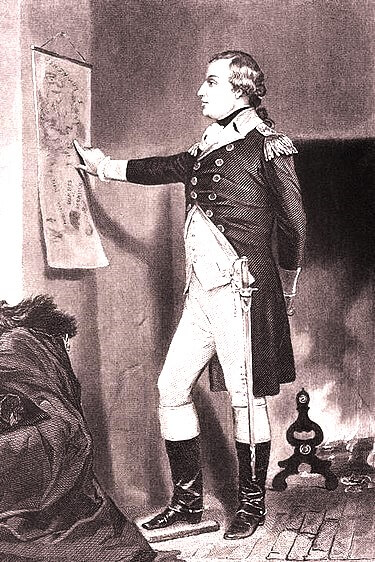
On August 18th, Schuyler returned to Albany to participate in the conference with the Iroquois nations (discussed in article five) leaving final preparations for the invasion in the hands of General Richard Montgomery, next in command. Montgomery was a veteran of the French and Indian War, rising to the rank of Captain before returning to England. Ten years later he sold his commission, moved to America, purchased a farm north of New York City and married the daughter of Robert Livingston, gaining immediate recognition among the Colony’s political establishment. In June 1775, at the age of 37 he was appointed a brigadier general and assigned to the Northern Army by George Washington.
Arriving in Albany on July 15th to assist Schuyler in preparing for the invasion, Montgomery moved north to Fort Ticonderoga in August and was in this advanced position when intelligence was received that the British had three ships poised to move south toward Crown Point. In an August 29th letter to Schuyler, he expressed the need to immediately launch the expedition northward to meet this threat, while asserting his willingness to assume responsibly for his action.
I am much of [Major John Brown’s opinion that I think it is absolutely necessary to move down the lake with the most dispatch-should the enemy get their vessels in to the lake tis over with us for this summer…This intelligence has involved me in a great dilemma-the moving without your orders I don’t like, but on the other hand the prevention of the enemy is of the utmost consequence – If I must err I wish to be on the right side – the express will go night and day and I hope you will join us with all expedition.
Montgomery embarked from Crown Point on August 31st with 1200 men and reached Isle-Aux-Noix on September 3rd. Schuyler caught up with him the next General Richard Montgomery day and the army moved north toward Saint Jean. Over the course of the next six weeks two important British outposts were captured. The army lay siege to Saint Jean, but sallied 10 miles north to capture lightly defended Fort Chambly on October 18th. Approximately 100 prisoners, including family members of soldiers defending Saint Jean, were transported south to an overnight stop at Ticonderoga before moving further south.
Two weeks later, on November 3rd, Major Charles Preston surrendered 466 solders of the 7th and 26th regiments, plus another 250 volunteers, sailors, workmen and women. Most of them also passed through Ticonderoga on their way south. Some were held over at the hospital facility at Fort George, sharing accommodations with sick American soldiers returning from Canada.
One of those that had already returned from Canada was Philip Schuyler himself. Sick with recurring gout and gastric illnesses he arrived back in Ticonderoga on September 17th where he remained until late November. His presence there was fortuitous in that he was able to more easily procure and direct both provisions and troops northward to the invading army now led by Montgomery.
From there Schuyler frequently updated Washington on the difficulties facing his invading army. Probably the biggest challenge was managing the troops themselves. New to the discipline of military protocol and the distress of campaigning as winter approached, desertion was a major problem. Soldiers without leave trickled back to Ticonderoga in groups. In a November letter to Washington, Schuyler described the situation.
Nothing can suppress the impatience of the troops from New England to get to their firesides. Nearly three hundred of them arrived a few days ago unable to do any duty. But as soon as I administered a discharge they instantly acquired health and undertook a march from here of two hundred miles with the greatest alacrity.
At one point both Schuyler and Montgomery threatened to resign due to the stress of the campaign but admonished by Washington, they continued to carry out their responsibilities. Schuyler pushed forward replacement troops northward as soon as they arrived at Ticonderoga, in support of the campaign, even as the sick and disenchanted streamed south.
At the hospital at Lake George Dr. Stringer was faced with dwindling supplies and a growing number of patients. In late November he informed Schuyler the sick wards currently held 99 patients and 200 more were on their way from Ticonderoga. He warned the General that “our strength is insufficient, and we now shall be incapable of giving attendance to the number we are likely to have.” He asked Schuyler “Would it not be best to remove the hospital, while we can to Albany?”
The Albany Committee was faced with overcoming many deficiencies in supporting the campaign. Medical facilities and barracks to house both arriving American troops headed north and British prisoners moving south needed attention. In October, the Provincial Congress in New York City provided both the pressure and the incentive (£200) to address the issue.
By the enclosed resolution you’ll see that the Barracks & Hospital or either of them as you may think proper are to be repaired & firewood to be provided. It is however the sense of this Congress that the burden of this Commission should not be troublesome to your Committee.
The Albany Hospital was a large wooden H-shaped building constructed during the French and Indian War that had fallen into disrepair. With its refurbishment, Dr. Stringer got his wish and led a small group of Albany doctors to treat sick and wounded soldiers.
Another concern was the question of what to do with the arriving prisoners. Most were soon passed along to detention sites downstate, in Connecticut or even Philadelphia. Some officers remained in Albany and became thorns in the side of the Albany Committee. One such was Captain Samuel McKay, captured at St. Jeans. While incarcerated here he had “behaved himself in discourse extremely insulting to the inhabitants of this city and county.” Worse, when called before the Committee he indicated that “he was the Kings Servant” and did not know why he needed to answer to them. Still worse, when he first appealed to Schuyler and then directly to George Washington for leniency, they rejected his appeal. Apparently General Montgomery, in a November letter to Schuyler had provided the basis for this rejection.
I wish I could have apprize you in time of your obligations to Captain McKay – He generously offered Mr. Carleton if he would give him two hundred men to go & burn the new church at Saratoga last summer! – He is so inveterate a fellow, that I think if the other prisoners should be indulged in returning to their families this winter, he ought not be permitted to enter this province.
Imagine McKay asking favors of Philip Schuyler, of all people. He was sent to Hartford Connecticut but escaped to Canada and got his chance to visit to Saratoga, serving under Burgoyne with a small group of provincials.
In Canada, Montgomery occupied Montreal in mid November after Governor Guy Carleton fled downriver to Quebec. General Richard Prescott surrendered the British ships and provisions to the American forces on November 20th, sending more prisoners south toward Albany. Prescott was noted for his mistreatment of Ethan Allen who had been captured after his premature attempt to enter Montreal at the Battle of Longue-Point in September. Prescott was sent to Philadelphia and exchanged for American General John Sullivan in 1776.
Montgomery’s Northern Army traveled down the St. Lawrence River in the captured ships and on December 1st joined forces with 675 men led by Benedict Arnold who had completed the arduous journey through the Maine wilderness. Together they moved to breach the walled city of Quebec with its few, well- protected defenders.
After a month of reconnaissance and probing Guy Carlton’s defenses, the two Generals, under time pressures to launch their assault before many of their troop’s enlistments ended on December 31st, agreed to a three-pronged plan of attack. Arnold’s New Englanders would attack the Lower Town and Montgomery would lead his Yorker regiments up from the river. A third column of Canadians would feign attacks from the Plains of Abraham toward the western walls of the city. The attack was launched in a snowstorm on the last day of 1775.
It did not go as planned. Montgomery led his men up the rocky path through the barricades. He was killed instantly by cannon fire from a blockhouse, as were several of his subordinates. Arnold received a serious leg wound from shots fired from the fortress walls. The attack failed, as ultimately did the attempt to add a fourteenth colony to the American experiment. The army remained encamped outside the walls throughout the winter until forced to retreat back to New York in May 1776 with the arrival of eight British regiments under Major General John Burgoyne. The campaign had ended but the fight for independence had just begun.
On January 19th, 1776, Albany paid their respects to the fallen General Richard Montgomery whom they had supported throughout the campaign:
Resolved that the Committee of this County Condole the Death of the Brave General Richard Montgomery, by wearing each a Crape round their Arm for six weeks from this day successively.
Sources:
Colonial Albany Social History Project, Stephan Bielinski, Welcome To The Colonial Albany Project Website
Colonel John Brown: His Services in the Revolutionary War, Rev Garret R.Roof, 1884, Internet Archive
Founders Online – Correspondence of Richard Montgomery, Philip Schuyler, and George Washington, Aug – Dec 1775, Founders Online: Home
David Wooster Kept the Men at Quebec: Giving Credit to a Much-Maligned General, Mark R. Anderson, Journal of the American Revolution, May 13,2021
Letters to Major General Philip Schuyler, New York Public Library online collection. Transcribed by Joseph Robertaccio, July 1775 – Jan 1776
Minutes of the Albany Committee of Correspondence 1775-1778, compiled by James Sullivan, State Historian, 1923
Proud Patriot: Philip Schuyler and the War for Independence, Don R. Gerlach, 1987
The Battle for the Fourteenth Colony, Mark R. Anderson, 2013
 Keep America’s Turning Point Alive

Keep America’s Turning Point alive for generations to come by making a tax-deductible donation to the Campaign for Saratoga 250, Inc. Our certified 501c3 nonprofit organization is dedicated to promoting awareness, education, and preservation of critical assets of the Battles of Saratoga. Your support will help promote historical awareness of new generations of people across the region, nation, and globe.